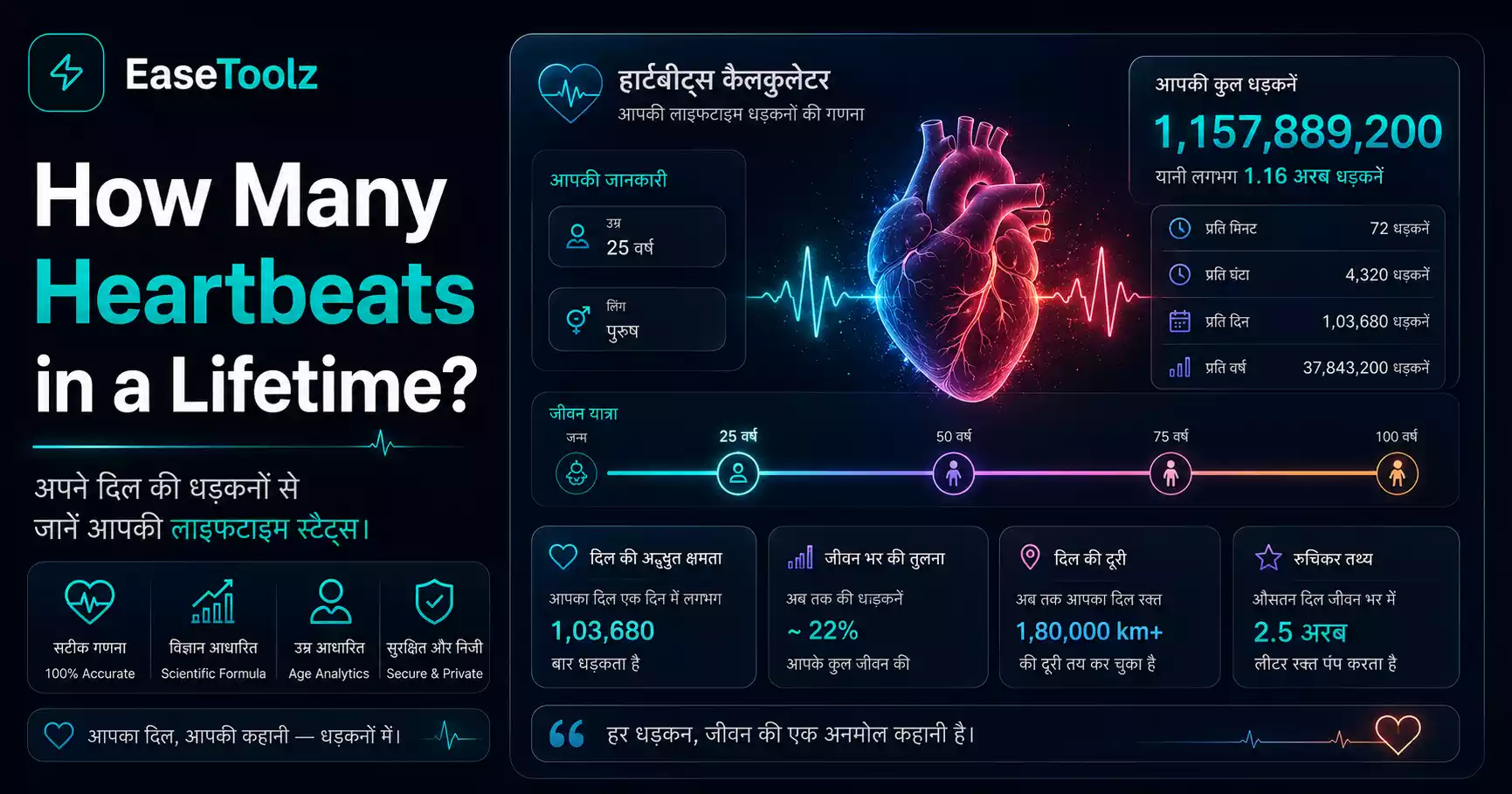
The average human heart beats approximately 2.5 billion times in a 70-year lifetime. At a resting rate of 72 beats per minute, that works out to 103,680 beats per day, 37.8 million beats per year, and over a billion beats by the time you reach your early thirties. If you have lived 30 years, your heart has already beaten more than 1.1 billion times.
Quick answer: A 70-year human lifetime contains roughly 2.5 billion heartbeats at an average of 72 bpm. At 30, you've crossed 1.1 billion. At 50, you've passed 1.9 billion. Enter your exact date of birth in our Age Calculator to get your personal lifetime heartbeat count to the day.
Last Updated: June 2026
The Math Behind Your Lifetime Heartbeat Count
The calculation is surprisingly straightforward. The heart beats at an average resting rate of 72 beats per minute for most healthy adults — this figure is the middle of the normal resting range (60–100 bpm) and is widely used in physiology textbooks.
The formula:
Beats per day = 72 × 60 min/hr × 24 hr/day = 103,680
Beats per year = 103,680 × 365.25 days = 37,869,120
Beats by age X = 37,869,120 × X
At exactly age 30, that gives you: 1,136,073,600 heartbeats. Over a billion beats, and you are still in the first half of a typical lifespan.
This number is often cited as the reason cardiologists say "the heart has a fixed number of beats" — though modern science has largely debunked the strict version of that idea. The heart does not have a predetermined total that expires; rather, a lower resting heart rate (achieved through fitness) spreads those beats more efficiently over time.
Why 72 bpm is used as the baseline
The normal adult resting heart rate ranges from 60 to 100 beats per minute. Elite athletes can have resting rates as low as 40 bpm. Anxious or unfit adults may rest at 90 bpm. The 72 bpm figure is a widely cited population average for healthy adults — it gives a useful baseline for comparison, even though your personal rate will differ.
Heartbeats by Age — A Running Total
Here is the cumulative heartbeat count at key ages, using the standard 72 bpm formula:
| Age | Total Heartbeats | In Human Terms |
|---|---|---|
| 18 | ~681 million | 681,696,000 |
| 25 | ~947 million | 946,748,000 |
| 30 | ~1.14 billion | 1,136,073,600 |
| 40 | ~1.51 billion | 1,514,764,800 |
| 50 | ~1.89 billion | 1,893,456,000 |
| 60 | ~2.27 billion | 2,272,147,200 |
| 70 | ~2.65 billion | 2,650,838,400 |
(Calculations based on 72 bpm × 103,680 beats/day × 365.25 days/year)
A few milestones worth noticing:
- You cross 1 billion heartbeats around age 26.4
- You hit 2 billion around age 52.8
- The average global life expectancy (~73 years) puts the lifetime total at approximately 2.76 billion beats
These numbers assume a constant resting rate, which nobody has. Real heart rate fluctuates with sleep, exercise, stress, and emotion — meaning some days add 150,000 beats and a night of deep sleep might add only 65,000.
What Affects Your Lifetime Heartbeat Count?
Several factors shift your total in meaningful ways, both up and down.
1. Fitness level
This is the single biggest variable. A marathon runner with a resting heart rate of 45 bpm accumulates beats 37% slower than someone at 72 bpm. Over 70 years, the difference adds up to roughly 900 million fewer heartbeats. Regular aerobic exercise (30 minutes, 5 days a week) can lower resting heart rate by 5–15 bpm over months.
2. Sleep quality
The heart slows significantly during deep sleep — falling to 40–50 bpm in healthy sleepers. Eight hours of good sleep versus eight hours of poor, fragmented sleep can mean a difference of thousands of beats per night.
3. Chronic stress and anxiety
Sustained stress raises cortisol, which keeps resting heart rate elevated — sometimes by 10–20 bpm above baseline. Over years, this meaningfully inflates the cumulative total and contributes to wear on the cardiovascular system.
4. Body size and genetics
Larger people generally have slightly lower resting heart rates because the heart can pump more volume per beat. Women typically have slightly higher resting rates than men (2–7 bpm on average). Genetics also plays a role — some people are born with naturally efficient hearts.
5. Altitude
At high altitude, less oxygen per breath forces the heart to beat faster to deliver the same oxygen load. People living above 3,000 metres permanently accumulate beats faster than people at sea level.
6. Medications
Beta-blockers (prescribed for hypertension) deliberately slow the heart rate. Stimulants like caffeine, decongestants, and some antidepressants raise it. If you take any of these regularly, your actual lifetime total will differ from the 72 bpm baseline estimate.
The Heart's Most Extreme Records
The human heart is remarkably adaptable. Here are some of the extremes recorded in medical literature:
Lowest resting heart rate ever recorded: 27 bpm — by cyclist Miguel Indurain, five-time Tour de France winner. His heart was so efficient it could pump the same blood volume at half the rate of an average adult.
Highest safe training heart rate: Around 200 bpm during intense exercise for a young adult (roughly 220 minus age). At this rate, the heart beats nearly 3× faster than at rest.
Longest cardiac arrest survived: In 2019, a Norwegian woman was revived after her heart stopped for 95 minutes following near-drowning in freezing water. Cold temperatures dramatically slow the body's need for oxygen.
Heart rate during REM sleep: Can drop to 40–50 bpm even in non-athletes — the body's natural repair window, when the heart gets its closest thing to a rest.
These records illustrate that the 72 bpm baseline is a useful average, not a fixed constant. Your personal heart has its own rhythm, shaped by every year of your life.
Your Personal Heartbeat Counter
Every number above is an estimate at 72 bpm. Your heart does not beat at exactly 72 — it has been faster in stressful moments, slower in deep sleep, racing during your first love, slowing during meditation.
But if you want your personal estimated total — the best approximation based on your exact age to the day — our Age Calculator gives it to you instantly. Enter your date of birth and open the Bio tab to see:
- Your total estimated heartbeats to this exact moment
- A live heartbeat ticker incrementing in real time (~833ms per beat at 72 bpm)
- Cumulative totals at key ages for comparison
- Breaths taken, blinks completed, and more biological counts
The counter is based on 72 bpm and your exact age in days — so it is as precise as a single baseline rate allows.
Calculate your heartbeat count →
There is something genuinely affecting about watching that counter tick. Each beat represents about 0.83 seconds of your life. By the time you finish reading this sentence, your heart has beaten another 5 or 6 times.
Frequently Asked Questions
How many times does the human heart beat in a lifetime?
Approximately 2.5 billion times in a 70-year lifetime at an average resting rate of 72 bpm. At 80 years, the total reaches roughly 2.86 billion beats. The number varies based on individual resting heart rate, fitness level, and lifespan.
How many times does the heart beat per day?
At 72 bpm: 72 × 60 × 24 = 103,680 beats per day. At 60 bpm (fit adult), that drops to 86,400. At 80 bpm, it rises to 115,200.
At what age do you cross 1 billion heartbeats?
At a resting rate of 72 bpm, you cross 1 billion heartbeats at approximately age 26 years and 5 months. If your resting rate is lower (athletic), it takes longer. If higher, you reach it sooner.
Does a faster heart rate mean a shorter life?
Research does suggest a strong correlation between lower resting heart rate and longevity — but the cause is cardiovascular fitness, not the heartbeat count itself. Exercise lowers resting heart rate AND extends life — the lower beat count is a marker, not the mechanism. You cannot simply slow your heart artificially and expect to live longer.
How accurate is the heartbeat estimate?
The formula (age in days × 103,680) assumes a constant 72 bpm over your entire life, which is a simplification. Real heart rates change significantly with age, fitness, health, and daily circumstances. The estimate is a compelling approximation, not a precise medical figure.
Can I see my heartbeat count live?
Yes — the Age Calculator on EaseToolz includes a live heartbeat ticker on the Bio tab that increments in real time based on your date of birth. It recalculates every ~833 milliseconds (one beat at 72 bpm).