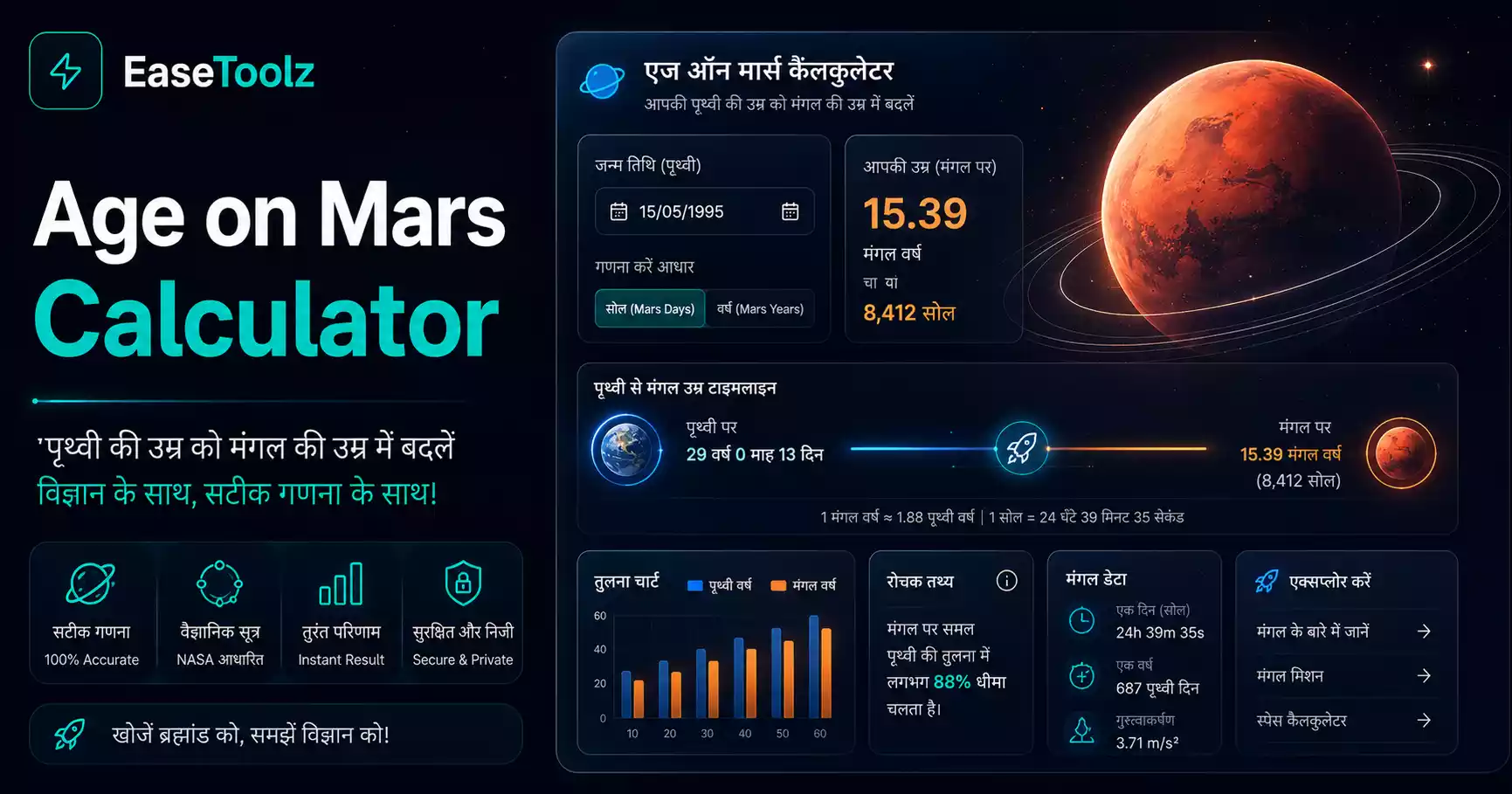
If you are 30 years old on Earth, you are only 15.9 years old on Mars. On Jupiter, you are just 2.5 years old. On Mercury, you would be an ancient 124 years old. Your age is not a fixed number — it depends entirely on which planet you happen to be standing on.
Quick answer: On Mars, divide your Earth age by 1.88 (Mars completes one orbit in 1.88 Earth years). A 30-year-old is 15.96 Mars years old. A 25-year-old is 13.3. A 40-year-old is 21.3. Try the Age Calculator to see your age on all 7 planets instantly.
This is not a trick or approximation. It follows directly from how we define a "year" — as one complete orbit around the Sun. Every planet takes a different amount of time to complete that journey, so every planet has a different year length.
Last Updated: June 2026
Why Your Age Depends on Which Planet You're Standing On
When someone asks "how old are you?", the answer assumes you have been measuring time in Earth years — 365.25-day orbits around the Sun. But that convention only makes sense because we live on Earth.
A "year" is literally just one planetary orbit. Earth's orbit takes 365.25 days. That is not a law of physics — it is just how long our particular planet takes to travel around our particular star.
Mars takes 686.97 Earth days to orbit the Sun (1.88 Earth years). So a Martian year is almost twice as long as an Earth year. If you have lived through 30 Earth years, you have lived through fewer than 16 complete Martian years — making you 15.9 years old in Martian reckoning.
The formula
Planetary age = Earth age ÷ Planet's orbital period (in Earth years)
That is all there is to it. No complex physics — just a ratio of orbital periods.
Mercury orbits in just 0.241 Earth years (88 Earth days). So each Earth year contains more than four Mercury years. A 30-year-old on Earth has lived through 124.5 Mercury orbits — they would be elderly by Mercurian standards.
Neptune, at the other extreme, takes 164.8 Earth years per orbit. Nobody alive on Earth today has lived through even one complete Neptunian year.
How Old Are You on Mars? (The Math)
Mars is the most discussed planetary age comparison because:
- It is our most realistic near-future destination for human exploration
- Its orbital period (1.88 years) gives ages that feel meaningfully different from Earth ages
- Young people on Earth are middle-aged by Martian reckoning — and vice versa
Mars orbital period: 686.97 Earth days = 1.8808 Earth years
To find your Mars age: Earth age ÷ 1.8808
Some examples:
- Age 20 on Earth → 10.6 on Mars
- Age 25 on Earth → 13.3 on Mars
- Age 30 on Earth → 15.96 on Mars
- Age 35 on Earth → 18.6 on Mars
- Age 40 on Earth → 21.3 on Mars
- Age 50 on Earth → 26.6 on Mars
- Age 60 on Earth → 31.9 on Mars
This means the legal drinking age on a hypothetical Mars colony (if set at 18 Martian years) would not be reached until age 33.9 Earth years. Every generation would effectively be "younger" than their Earth counterpart in legal and social terms.
Your Age on All 8 Planets — Complete Table
Here is the full comparison for three common Earth ages:
| Planet | Orbital Period (Earth yrs) | Age if 25 on Earth | Age if 30 on Earth | Age if 40 on Earth |
|---|---|---|---|---|
| Mercury | 0.241 | 103.7 yrs | 124.5 yrs | 165.9 yrs |
| Venus | 0.615 | 40.7 yrs | 48.8 yrs | 65.0 yrs |
| Earth | 1.000 | 25.0 yrs | 30.0 yrs | 40.0 yrs |
| Mars | 1.881 | 13.3 yrs | 15.96 yrs | 21.3 yrs |
| Jupiter | 11.862 | 2.11 yrs | 2.53 yrs | 3.37 yrs |
| Saturn | 29.458 | 0.85 yrs | 1.02 yrs | 1.36 yrs |
| Uranus | 84.011 | 0.30 yrs | 0.36 yrs | 0.48 yrs |
| Neptune | 164.800 | 0.15 yrs | 0.18 yrs | 0.24 yrs |
A few numbers that should stop you mid-scroll:
On Jupiter, a 30-year-old Earth person is only 2.53 years old. An entire elementary school class would be celebrating their first Jovian birthday. Children born today will not reach their first Jovian year until 2037.
On Saturn, today's newborns will not complete one orbit until the year 2055 — when they will be 29 years old on Earth but technically turning one on Saturn.
On Neptune, the last person to complete one full Neptune orbit was born before any living person can remember. Neptune's discovery in 1846 means it has completed less than one orbit since humans first observed it.
The Most Surprising Planetary Ages
Mercury makes everyone old
At 0.241 Earth years per orbit, Mercury is the fastest planet in the solar system. Every single Earth year contains 4.15 Mercury years. A 10-year-old child on Earth has lived through over 41 Mercury years. A healthy 70-year-old has completed 290 Mercury orbits. Age is relative, and on Mercury, everyone is ancient.
On Jupiter, there are no adults
The oldest living humans — those at 115 years or older — are still less than 10 Jovian years old. In the entire recorded history of humanity, only about 11 complete Jupiter orbits have passed. Your great-great-grandparents lived in Jupiter's previous orbit.
Saturn's ring system is younger than some people think
Saturn's famous rings are estimated to be between 10 million and 100 million years old. In Saturnian years, that means the rings are between 340,000 and 3.4 million Saturn years old. Ancient by any measure.
No human has ever lived one Neptune year
Neptune was discovered in September 1846. It completed its first full observed orbit in July 2011 — 164.8 years later. No human born before that discovery is alive today to have witnessed the full orbit. The planet is older than any human but has barely moved from an orbital perspective.
Planet Age vs Earth Age — What Does It Actually Mean?
Planetary age is a thought experiment that reveals how arbitrary our calendar units are. An "Earth year" feels natural to us because we evolved on this planet and calibrated our biology (and our psychology) to its orbital cycle.
If humanity had evolved on Mars — if Martian years were our baseline — we would celebrate our "Martian first birthday" at what would otherwise be 1.88 Earth years old. Children would start school at 5 Martian years (age 9.4 Earth). A Martian retiree at 65 Martian years would be 122 years old on Earth.
This is not just trivia. Future human colonies on Mars will face a genuine choice: do you track age in Earth years (the biological and legal standard until space colonization) or Martian years (the local orbital reality)? The answer will matter for everything from legal systems to birthday traditions.
The philosophical angle
Planetary age also highlights that our sense of "how old" something is carries hidden assumptions. When we say a geological feature is "100 million years old," we mean Earth years. The same feature measured in Neptune years would be 607,000 years old — the same physical age, completely different number.
Numbers are not age. Age is the actual elapsed time of existence, and numbers are just the units we use to label it.
Calculate Your Exact Planetary Age
The EaseToolz Age Calculator calculates your exact age on all 7 planets (Mercury through Neptune, excluding Earth) based on your specific date of birth. Unlike static tables, it uses your precise age in days to give fractional planetary years — so if you are 30 years and 147 days old on Earth, you will see your exact Mars age is 15.96 + (147 ÷ 686.97) = 16.18 Martian years old.
The Planets tab also shows:
- Your age on all 7 other planets simultaneously
- Orbital periods in Earth days and Earth years
- Which planetary "birthday" you are approaching next
Calculate your planetary age now →
After you see your Mars age, share it: "On Mars I'm only [X] years old 🪐" consistently gets strong reactions on social media because it is simultaneously surprising, verifiable, and makes people immediately want to check their own number.
Frequently Asked Questions
How do I calculate my age on Mars?
Divide your Earth age by 1.8808 (Mars's orbital period in Earth years). Example: 30 ÷ 1.8808 = 15.96 Mars years. For an exact result based on your specific birthdate, use the Age Calculator.
Which planet would make me the youngest?
Neptune — with a 164.8-year orbit, no living human has completed even one Neptunian year. A 30-year-old on Earth is just 0.18 Neptune years old.
Which planet would make me the oldest?
Mercury — orbiting every 0.241 Earth years. A 30-year-old on Earth has lived through 124.5 Mercury orbits. On Mercury, you would be considered ancient.
Why is a year different on each planet?
A year is simply the time for one complete orbit around the Sun. Planets closer to the Sun orbit faster (shorter year) due to higher gravitational pull at shorter distances. Planets further away move slower and have longer years.
Does your biological age change on other planets?
No. Your cells, brain, and body age at the rate determined by your biology, regardless of which planet you are on. Planetary age is a mathematical counting convention, not a biological reality. The thought experiment assumes you are counting orbits from your planet of residence.
Would a Mars baby grow up faster than an Earth baby?
Biologically, no. Development follows cellular biology, not orbital calendars. A child born on Mars (someday, hypothetically) would develop at the same physical rate as an Earth child. They would just celebrate fewer birthdays per Earth year — making each birthday feel more significant.